Information Disclosure Statement Generator (Sienna)
Hand it the patent numbers you need to disclose and it writes the Information Disclosure Statement for you: it looks each reference up, finds the dates and the first named inventor, sorts them into the four tables the Patent Office expects, numbers them straight through, and saves a Word document you can check, sign and file.
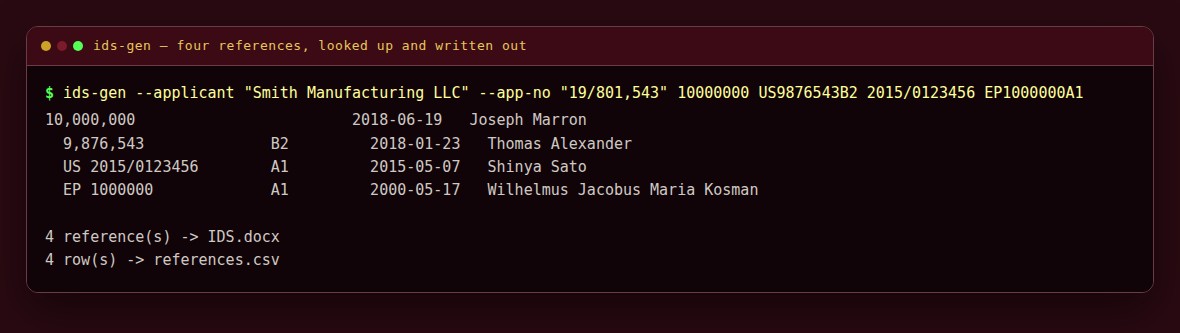
It prints what it found for each reference as it goes, and tells you which ones it could not find.
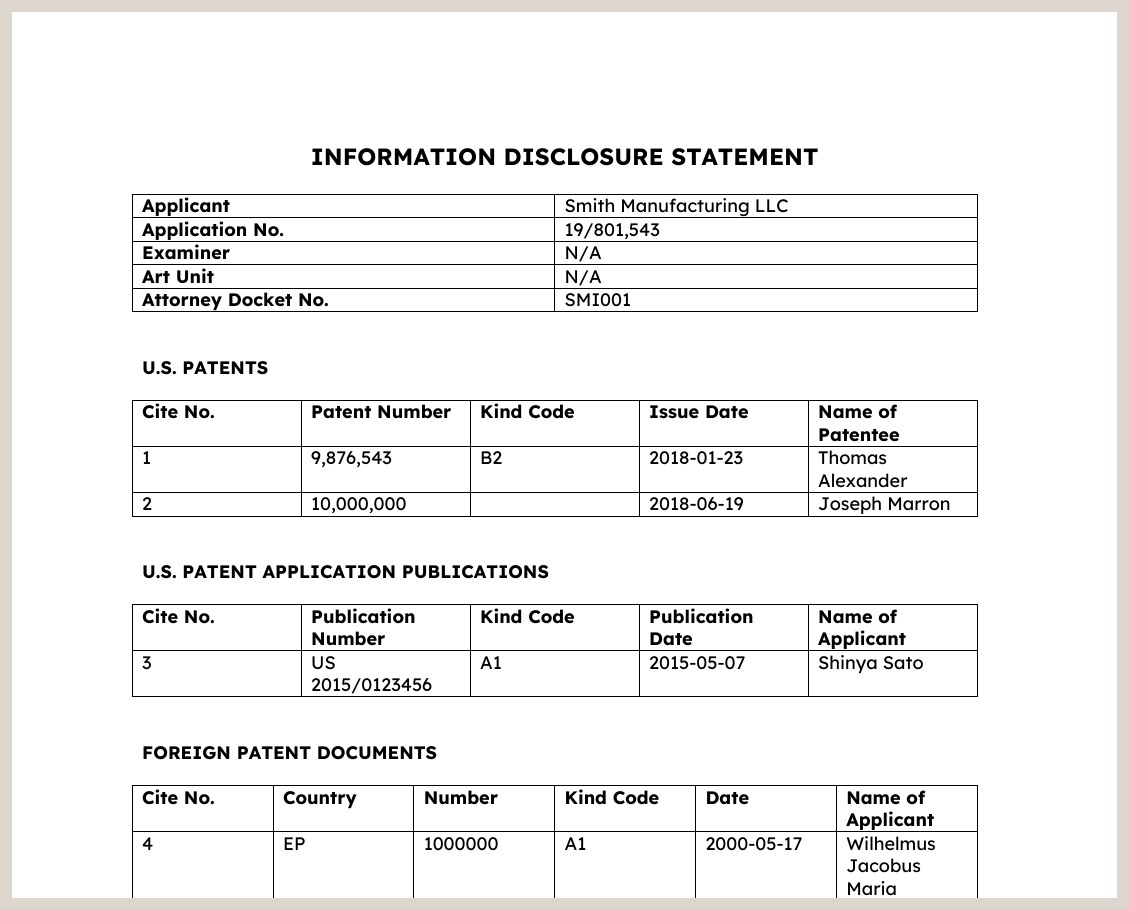
The Word document it saves. Open it, check it, add your signature, file it.
Not legal advice, and not a substitute for reading the references. This is a typing tool. Check every line against the document itself before you file anything, and check the rules in force when you file (37 CFR 1.97 and 1.98). Nothing is sent to the Patent Office by this program.
What it does
- You give it numbers, in whatever shape they come in:
10000000,US 9,876,543 B2,2015/0123456,EP1234567A1, or the name of a journal article. - It sorts them out. US patents, US published applications, foreign documents and other literature each go to their own table, in number order, numbered 1, 2, 3... in one run across all four.
- It fills in the dates and the inventor from the published record for each patent, and says so plainly when it cannot find one, so nothing is quietly left blank.
- It writes a Word document — headings, the applicant block, the tables and the certification paragraph — that you finish in Word and file as usual.
- It can read a folder of prior-art PDFs and take the numbers from the file names, which is how they usually arrive.
- It never files anything and never touches the Patent Office.
How you use it
One line, with the numbers:
python3 ids_gen.py --out IDS.docx --applicant "Smith Manufacturing LLC" \
    --app-no "19/801,543" --docket "SMI001" \
    10000000 US9876543B2 2015/0123456 EP1234567A1
Or from the folder the prior art already lives in:
python3 ids_gen.py --from-folder "Prior Art" --out IDS.docx --csv references.csvIt prints a line per reference as it goes, writes the document, and ends by naming anything it could not look up so you can fill those in yourself.
Information for nerds: options, lookups and tests
| Option | What it does |
|---|---|
numbers... | References on the command line, in any of the shapes above |
--from-file FILE | One reference per line; # starts a comment |
--from-folder DIR | Take the numbers from the names of the PDFs in a folder |
-o, --out FILE | The Word file to write (default IDS.docx) |
--csv FILE | Also write what was found as a spreadsheet |
--applicant, --app-no, --filed, --title, --docket | Fill in the header block |
--examiner, --art-unit | Default to N/A, which is right for an application that has not been examined |
--attorney | Name under the signature line |
--no-lookup | Stay offline and list the numbers exactly as given |
Where the data comes from. Each patent's own published record on Google Patents, read from the page's metadata: filing date (DC.date scheme=dateSubmitted), issue or publication date, and the first named inventor. A granted patent carries its issue date with scheme="issue"; a publication has a plain DC.date instead, and the program knows the difference. There is a short pause between lookups, to be a polite visitor. Anything it cannot find is listed at the end rather than left silently empty.
Duplicates are dropped: the same number given twice, or a number that also turns up in the folder, is listed once.
Requirements: Python 3.9 or newer and python-docx (pip install python-docx, or sudo apt install python3-docx).
Tests:
python3 -m unittest discover -s tests -vThey cover the classifying, the number shapes, the folder reading and the document itself, and never go online.
License
MIT. See LICENSE. Written with AI assistance (Claude).